
A guest orders a medium-rare steak with no onions, then glances at their watch. The next 60 seconds decide everything. Does that order reach the kitchen exactly as spoken? Or does it turn into a mix-up that costs your restaurant a repeat customer?
That one-minute window sits between a waiter taking an order and the kitchen starting on it. It has quietly become one of the most important metrics in restaurant service today. Call it the 60-Second Rule: the shorter and more accurate that gap, the better your dining experience holds up under pressure. Instant order sync is what closes it.
Why the First 60 Seconds Matter So Much
Order accuracy is not a minor operational detail. Industry benchmarks and puts average order accuracy across major restaurant chains between 86 and 89 percent. That means roughly 1 in 7 or 8 orders leaves the kitchen wrong, even at heavily audited locations. Independent, full-service restaurants rarely get audited this closely. They have little reason to assume they do better.
Kitchen staff rarely cause these errors by misreading a ticket. The real problem starts earlier. A handwritten note gets smudged. A waiter mishears a modifier. A scrap of paper never makes it past the pass. One widely cited industry study traces most quick-service order errors back to human input at the point of capture, not to kitchen preparation.
This is exactly where instant order sync earns its place in your restaurant’s tech stack.
What Instant Order Sync Actually Does
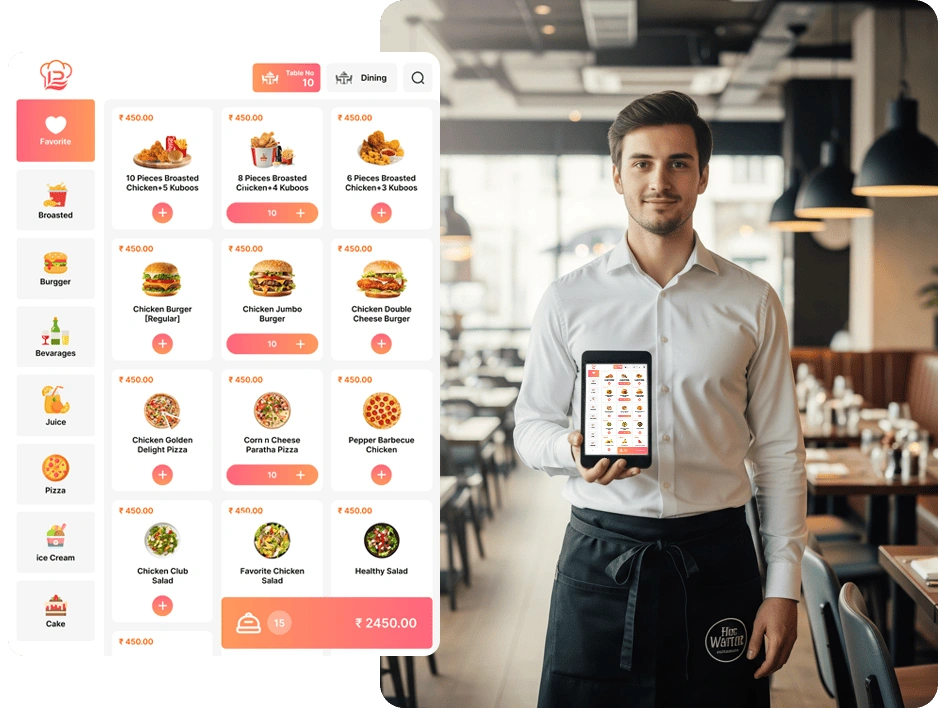
A waiter app connects directly to your POS software and removes the paper step entirely. The waiter enters the order tableside, on a phone or tablet. It lands on the kitchen display or KOT printer within seconds, not minutes. Nobody walks to a fixed POS terminal. Nobody re-keys the order. No modifier gets dropped along the way.
Instant order sync compresses that critical 60-second window in a few concrete ways:
- Order management happens in real time. Waiters can adjust or confirm details before they leave the table.
- Instant updates put the order in front of kitchen staff the moment the waiter taps send, not whenever they find a free terminal.
- Table management ties every order to a specific table number, so nothing gets mixed up during a rush.
- Order accuracy improves because the process skips manual re-entry, the step where details usually get lost.
The guest’s request moves from their mouth to the kitchen’s screen almost instantly. Nothing gets lost in between.
The Guest Experience Impact
Guests rarely think about POS software or kitchen display systems. They notice two things: does their food arrive correctly, and how long did it take? A restaurant that nails both consistently builds the kind of trust that shows up in repeat visits and better reviews.
Instant order sync affects the guest experience in a few visible ways:
- Shorter perceived wait times. A waiter can confirm an order went through the moment they took it. Guests feel attended to before the food even arrives.
- Fewer awkward corrections. A wrong plate damages a dining experience fast, especially for allergies or dietary requests.
- Smoother payment handoff. Integrated payments at the table mean guests pay as soon as they’re ready, not whenever a waiter prints the check.
- More consistent service during a full house. Waiters no longer queue at one terminal to enter orders, so service stays steady during peak hours.
Restaurants juggling dine-in alongside delivery and online orders feel this benefit even more. Off-premises demand now makes up a larger share of restaurant traffic than it did a few years ago. Front-of-house teams already have less time to walk back and forth to a fixed POS station.
Turning Instant Order Sync Into a Habit
Installing an app is only step one. Instant order sync works best paired with a few operational habits:
- Standardize how waiters enter modifiers, so allergy notes and substitutions get captured the same way every time.
- Treat the kitchen display as the single source of truth. Don’t let verbal shortcuts creep back in during rushes.
- Track how long orders take to move from table to kitchen. Reports and analytics tools make this easy to monitor over time.
- Train new staff on the app before their first live shift. Confidence with the tool speeds up every order after that.
Restaurants that measure this window, instead of assuming it takes care of itself, tend to see the biggest gains in both accuracy and guest satisfaction.
The Takeaway
The 60-Second Rule boils a complex problem down to one question: how fast and accurately can a spoken order become a kitchen-ready ticket? Instant order sync closes that gap almost entirely. It cuts the errors that come from paper tickets and manual re-entry, and it gives guests a faster, more attentive dining experience.
Does your team still rely on paper pads or a single fixed terminal? That 60-second window is probably working against you. Tableside ordering and real-time kitchen sync, through a tool like the LithosPOS Waiter App, closes it fast, without changing your menu or your staff.
FAQ
What is instant order sync in a restaurant? Instant order sync means an order a waiter takes at the table reaches the kitchen display or printer within seconds, with no paper step or manual re-entry in between.
What is the 60-Second Rule? It describes the short window between a waiter taking an order and the kitchen receiving it. The faster and more accurate that handoff, the better the guest experience holds up.
How does a waiter app improve order accuracy? A waiter app lets staff enter orders directly on a handheld device. That removes manual re-entry and paper tickets, the two leading causes of order mistakes.
Does instant order sync work with kitchen display systems? Yes. Waiter apps sync directly with a kitchen display system or KOT printer, so kitchen staff see each order the moment it’s placed.
Can instant order sync help during busy hours? Yes. Waiters skip the queue at a fixed POS terminal, so table turnover improves and service stays consistent even during a full house.
Is instant order sync only useful for large restaurants? No. Independent restaurants, cafes, and quick-service spots all benefit from removing the paper step. Order errors and slow service hurt small operations just as much as large chains.
How does instant order sync affect payments? Most waiter apps also support tableside payment processing, so guests can pay as soon as they’re ready instead of waiting for a printed check.