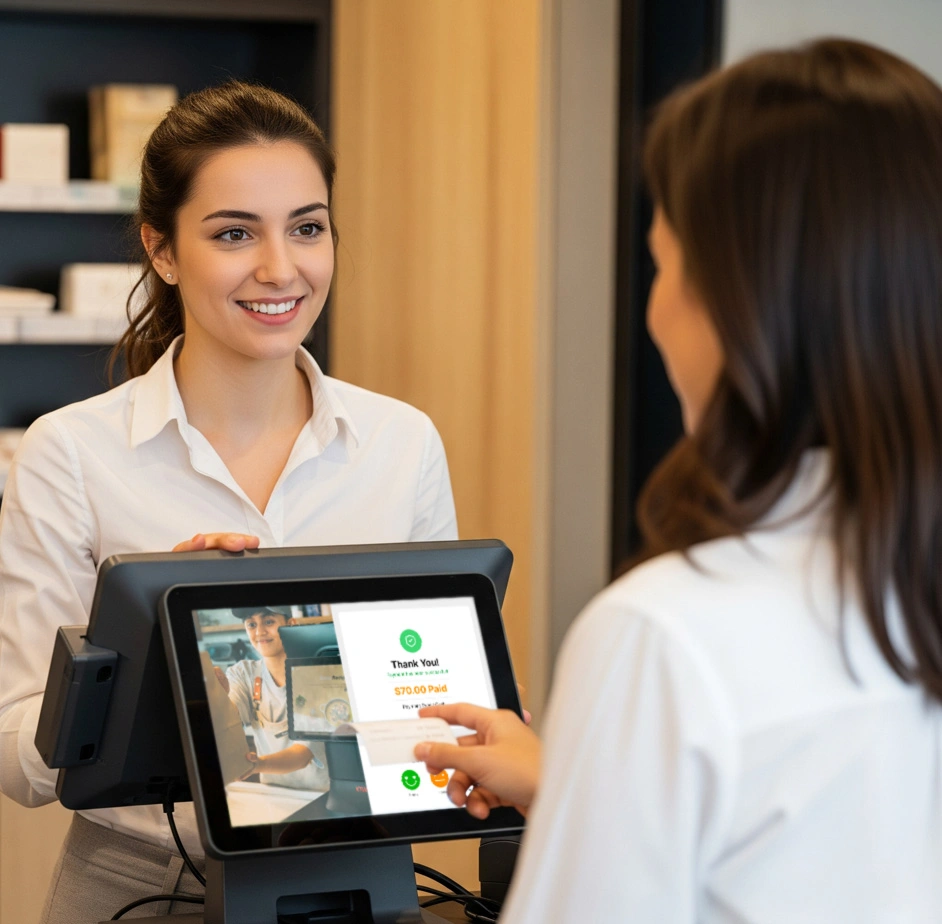
Ever watched a customer squint at the register, waiting to see the final number before they hand over their card? That small pause is doubt, and doubt, even for a second, chips away at trust. A real-time bill display removes that pause entirely, showing customers exactly what they owe as it adds up, item by item.
A customer display screen puts this real-time bill display in front of every customer. As items are scanned or an order is entered, the customer sees it happen line by line, in real time. No surprises at the end, no “wait, what was that charge for?”
Why a Real-Time Bill Display Builds Trust
Trust at checkout isn’t built with a receipt handed over after the fact. Customers build it during the transaction, watching their own bill add up. Billing stops being something that happens to them. It becomes something they’re part of.
This shift matters more than most retailers realize. A 2026 HubSpot survey of thousands of shoppers and marketers found that transparency has overtaken price as the single trait consumers value most in a brand. Businesses that openly shared pricing details saw measurably higher satisfaction scores (per Amra & Elma’s 2026 brand trust report). A customer who feels informed feels respected. And a customer who feels respected comes back.
The Hidden Cost of Checkout Without a Real-Time Bill Display
Without a real-time bill display, customers see only two things: the cashier’s screen, turned away from them, or a printed receipt at the end. That gap between “what am I being charged” and “here’s your total” is where doubt creeps in, even when nothing dishonest is happening.
A wrong price tag, a manager override, an extra item scanned twice: these small errors happen at every store. Staff usually fix them instantly. But if the customer finds out only after the fact, or has to ask, the fix doesn’t erase that flash of suspicion. Multiply that across hundreds of transactions a day. A store can quietly earn a reputation for feeling less trustworthy, even while doing nothing wrong.
A real-time bill display removes that gap by design. The customer sees the same running total the cashier sees, in the same moment. Doubt never gets a chance to form.
The Repeat-Customer Effect of a Real-Time Bill Display
First-time customers are naturally more cautious. They don’t yet know if a store rounds up, adds hidden fees, or fumbles totals. A real-time bill display answers that unspoken question before it’s even asked. Over time, that consistency turns a one-off visit into a habit. It also pairs naturally with other trust-building tools like a customer loyalty program that rewards customers for coming back.
This matters even more for businesses still building brand recognition. A well-known chain can lean on its reputation to earn a shopper’s benefit of the doubt. A newer or independent store doesn’t have that cushion. Every checkout is effectively a first impression. A real-time bill display helps smaller retailers earn trust fast, without years of brand history behind them.
How a Real-Time Bill Display Fits Into Modern POS Setups
A real-time bill display typically runs on a second screen connected to the same point-of-sale system the cashier uses. Both screens update together as items are scanned or an order is entered. Staff manage nothing extra. There’s no separate device and no manual step. This is what sets it apart from simply turning a cashier’s screen around. A dedicated display serves the customer’s view alone. It’s often larger, clearer, and sits at eye level.
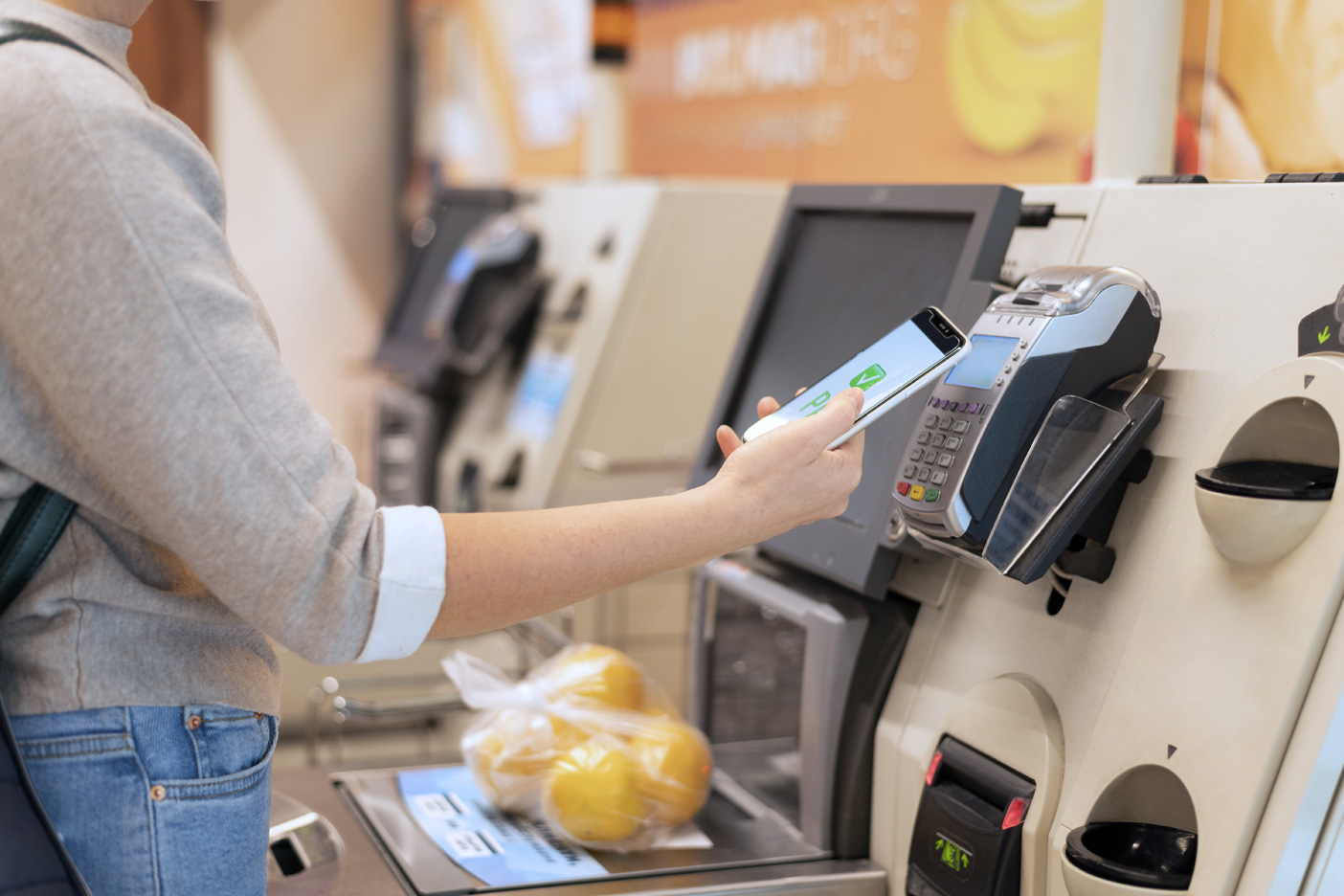
Many setups go further and use the same screen for contactless QR code and NFC payments. Customers can view, confirm, and pay from one display. When the register sits idle between customers, the screen can rotate through promotions or offers instead of sitting blank. That turns a trust feature into a small marketing channel too.
Beyond the Bill: What Else a Display Screen Can Do
A real-time bill display isn’t the only job a second screen can do at checkout. The same display can also show contactless QR payment options or promote in-store offers during idle moments, turning a trust tool into a small revenue driver as well.
FAQ
Does a customer display screen slow down checkout? No. It runs in sync with the POS in real time, so it adds visibility without adding steps or delay to the transaction.
Is a customer-facing display only useful for large retailers? No. Small and mid-sized retail stores and restaurants benefit just as much, since first-time customer trust matters most when a business doesn’t yet have brand recognition to fall back on.
What’s the difference between a receipt and a real-time bill display? A receipt confirms a transaction after it’s done. A real-time display shows the transaction as it happens, which is what removes the moment of doubt before payment.
Can a real-time bill display be used for anything besides billing? Yes. The same screen can show contactless payment QR codes and rotate through promotions or offers when the register is idle between customers.
Does adding a customer display require new hardware for every till? Most POS setups support adding a display per checkout counter, syncing to the same order data as the main register, so it can be added counter by counter rather than as a full system overhaul.
The Takeaway
A customer display screen isn’t just a convenience. It’s a quiet, constant trust signal. It tells every customer, every time: nothing to hide, nothing to double-check.
The point-of-sale (POS) system is no longer just a cash register. In 2026, the best POS systems act as the central nervous system of modern retail stores and restaurants – managing inventory, analyzing customer behavior, processing omnichannel orders, and even predicting tomorrow’s sales.
Whether you run a quick-service restaurant (QSR), a fine-dining establishment, a grocery chain, or a retail boutique, the POS system you choose in 2026 directly impacts your revenue, efficiency, and customer experience.
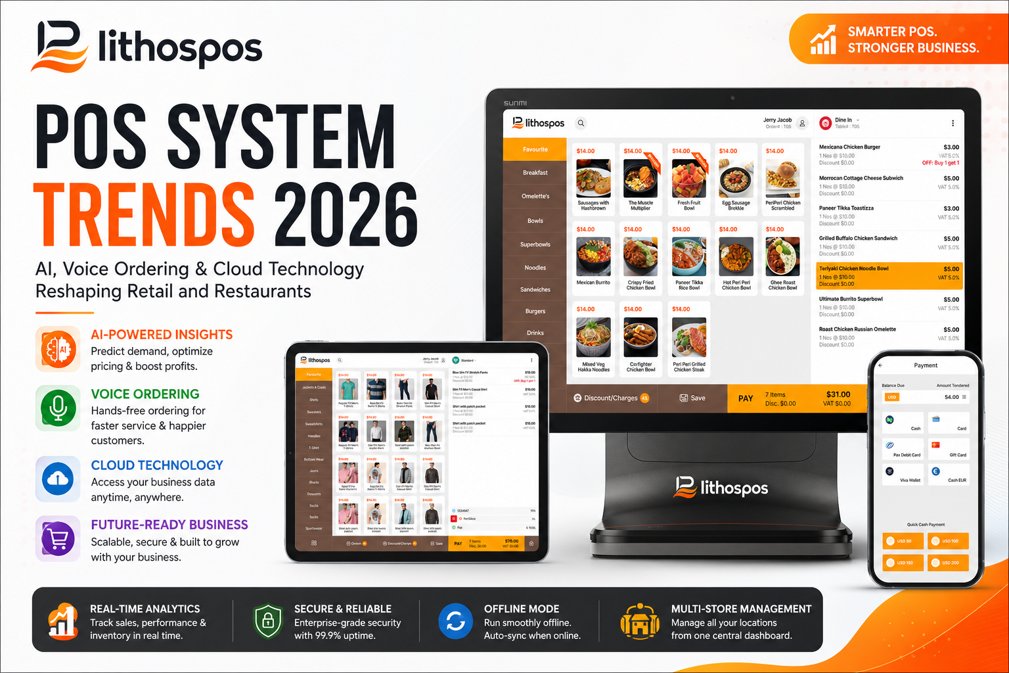
In this comprehensive guide, we break down the top 7 POS system trends for 2026, backed by industry data, and show you exactly how modern platforms like LithosPOS are leading this transformation.
What Are the Biggest POS System Trends for 2026?
The global point-of-sale terminal market is projected to reach $181.1 billion by 2030, growing at a CAGR of 9.9% (Grand View Research). This explosive growth is fueled by seven key technology shifts that are redefining what a POS system can do.
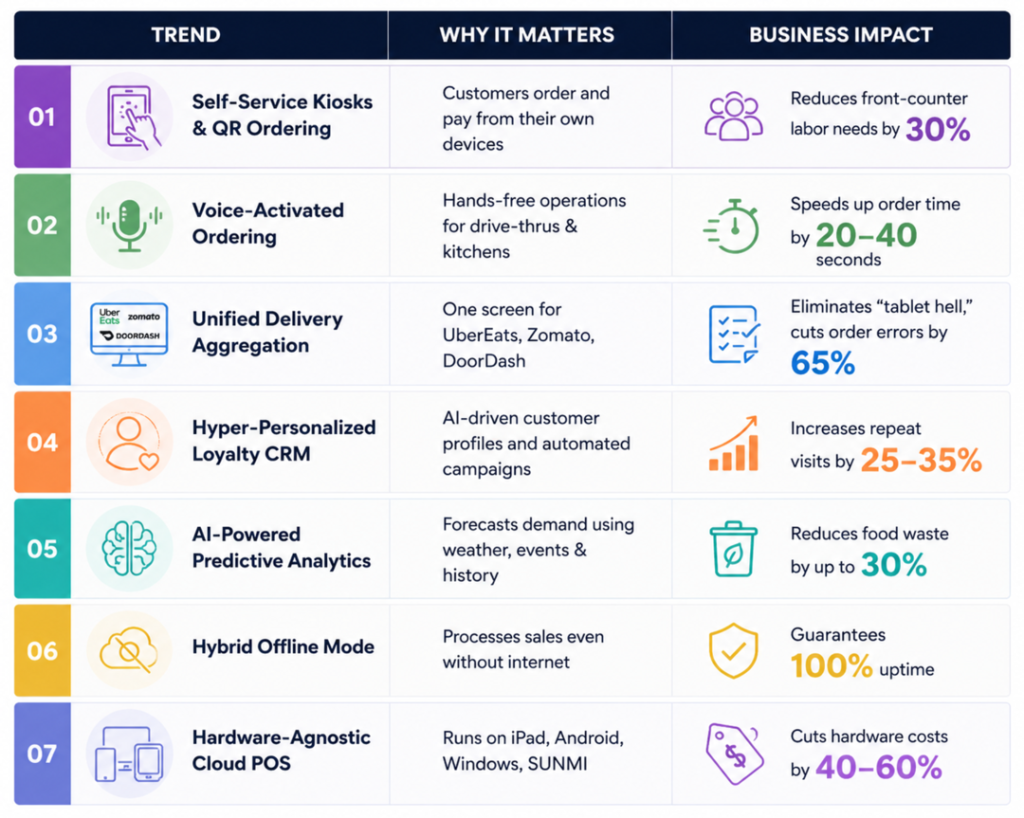
Here are the top POS trends every business owner needs to know in 2026:
1. AI-Powered POS Systems: From Data Collection to Predictive Action
How is AI changing POS systems in 2026?
Short answer: AI transforms your POS from a system that tells you what happened yesterday into one that tells you what will happen tomorrow and automatically takes action.
In 2026, the best AI-powered POS systems analyze massive datasets combining your historical sales, external factors like weather forecasts, local events, public holidays, and even social media trends to deliver predictive insights in real time.
According to Juniper Research, AI-driven automation in retail will save businesses over $340 billion annually by 2028 through smarter inventory management and dynamic pricing.
“Cold front expected this Saturday. Based on last year’s data, soup and hot beverage orders increased by 22%. Recommend prepping 20% extra.”
AI also enables dynamic menu pricing, slightly adjusting prices during peak and off-peak hours based on real-time demand, similar to how ride-sharing apps operate.
How AI-Powered POS Helps Retail
For retail businesses, AI solves the two biggest profit killers: stockouts and dead stock.
Stockout Prevention: The POS automatically generates purchase orders when inventory drops below a predicted threshold, not a static reorder point, but a dynamic one based on seasonal demand curves.
Dead Stock Reduction: AI flags slow-moving products early and suggests targeted discount campaigns before items become total losses.
How LithosPOS Uses AI
LithosPOS leverages advanced analytics and smart dashboard reporting to deliver actionable, real-time insights. From automated low-stock alerts to sales trend forecasting across multiple store locations, LithosPOS ensures your inventory is always optimized without the manual guesswork.
2. Voice-Activated POS: Conversational Commerce Enters the Kitchen
What is voice ordering in POS systems?
Short answer: Voice-activated POS technology allows restaurant staff and customers to place orders, check inventory, and manage operations using natural speech, with no screen tapping required.
We already talk to Alexa and Siri at home. In 2026, voice AI is making a massive leap into commercial POS environments.
Voice AI in Drive-Thrus and Quick-Service Restaurants
Quick-service restaurant (QSR) chains are rapidly deploying conversational AI bots at drive-thru windows.
These systems:
Take orders accurately through natural language processing (NLP)
Perfectly execute upselling prompts: “Would you like to add a medium fry for just $1.50 more?”
According to PYMNTS.com, drive-thru voice AI reduces average order time by 20-40 seconds per car, translating to significantly higher throughput during peak hours.
Hands-Free Staff Operations
In busy restaurant kitchens and retail stockrooms, staff can now:
Check real-time inventory levels by voice
Update order statuses hands-free
Clock in and out without touching a screen
Call up customer profiles during table-side service
This reduces screen dependency, speeds up operations, and improves hygiene, a growing priority in food service according to the National Restaurant Association.
3. Unified Delivery Aggregation: The End of “Tablet Hell.”
What is tablet hell in restaurants?
Short answer: “Tablet hell” refers to restaurants juggling 3-5 separate tablets for different delivery platforms (Uber Eats, DoorDash, Zomato, Grubhub, and more), each with its own interface, alert sounds, and manual order re-entry leading to errors, delays, and chaos.
In 2026, omnichannel POS integration is no longer a luxury feature. It is a baseline requirement for any serious restaurant or retail operation.
How Modern POS Systems Solve Tablet Hell
The best restaurant POS systems in 2026 feature direct API integrations with all major third-party delivery platforms.
Here is how it works:
A customer orders through Uber Eats, DoorDash, or Zomato
The order bypasses the front counter entirely
It flows directly into the POS and prints on the KDS
Kitchen staff prepare it just like a dine-in order, no manual re-entry
A McKinsey & Company report found that restaurants using unified order management reduce order errors by up to 65% and increase delivery throughput by 30%.
Centralized Menu Management
When you run out of avocado or a seasonal item, you update it once in your POS. The change instantly syncs across all connected delivery platforms, your website, and your self-service kiosks. No more logging into four different dashboards.
How LithosPOS Solves Tablet Hell
LithosPOS connects your business to 50+ integrations from delivery aggregators (Uber Eats, Zomato, Talabat, Deliveroo) to enterprise accounting platforms (SAP, Oracle, Zoho Books) and local payment gateways. Every order, from every channel, arrives on one single screen.
4. Hardware-Agnostic Cloud POS: The End of Vendor Lock-In
What is a hardware-agnostic POS system?
Short answer: A hardware-agnostic POS is software that runs on any device, iPads, Android tablets, Windows PCs, or industry-specific hardware like SUNMI and PAX, without requiring proprietary equipment from the POS vendor.
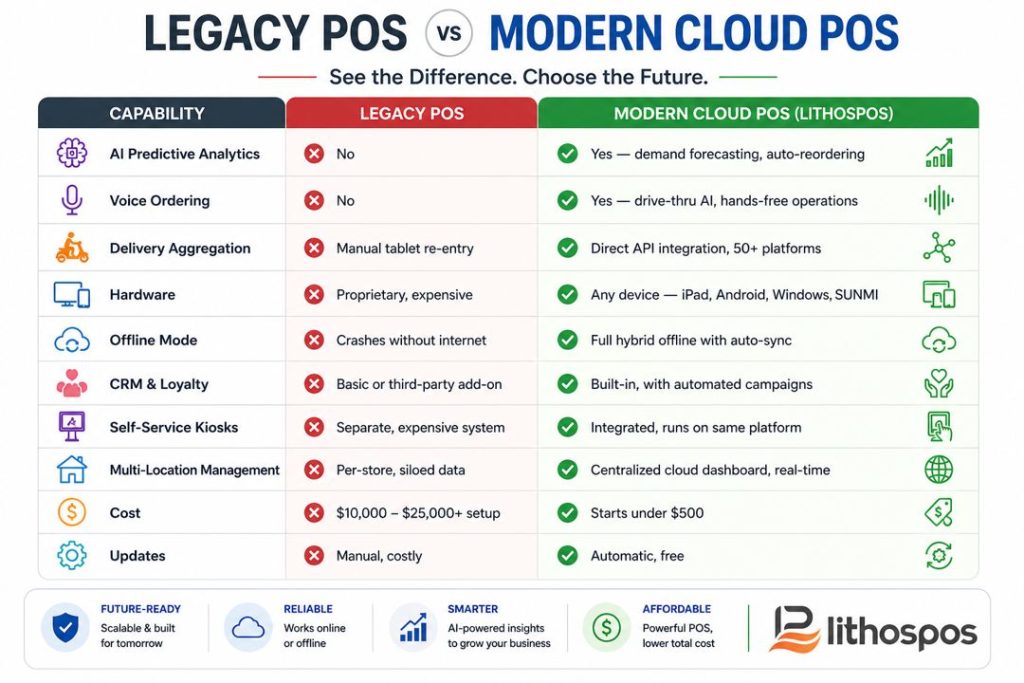
For decades, legacy POS companies forced merchants into buying their expensive, proprietary hardware. If a screen broke, you had to order their specific $1,500 replacement. If you wanted to open a new location, hardware costs could run into tens of thousands of dollars.
Why Hardware-Agnostic POS Matters in 2026
The biggest shift in the point-of-sale industry in 2026 is the widespread demand for Bring Your Own Device (BYOD) capability. According to Statista, cloud POS adoption has grown by over 300% since 2020, driven primarily by small businesses seeking affordable alternatives to proprietary terminals.
How LithosPOS Delivers Hardware Freedom
LithosPOS is 100% hardware-agnostic. Run our software on the Apple iPad, any Android tablet, a Windows desktop, or specialized restaurant hardware like SUNMI devices. You get enterprise-grade POS performance without the enterprise-grade price tag, giving you absolute freedom to scale without hardware lock-in.
5. Hyper-Personalized Loyalty Programs and CRM
How do modern POS systems handle customer loyalty?
Short answer: In 2026, the best POS systems include built-in Customer Relationship Management (CRM) tools that create detailed customer profiles, track purchase history, and trigger automated, hyper-personalized marketing campaigns, replacing generic punch cards forever.
The era of “buy 10, get 1 free” punch cards is over. Today’s consumers expect businesses to know them.
What Hyper-Personalized Loyalty Looks Like
When a regular customer walks into your coffee shop or logs into your digital ordering app, your POS should instantly pull up their profile:
“Hi Sarah, your usual iced oat milk latte? You’ve earned a $5 reward want to apply it today?”
This level of recognition builds emotional loyalty, not just transactional loyalty.
Automated Retention Marketing
Modern POS-integrated CRM tracks exactly what a customer buys and when.
Powerful automations include:
Predictive Reorder Reminders: If a customer buys pet food every 4 weeks, the system sends an SMS reminder at week 3 with a 10% discount code.
Lapsed Customer Win-Back: If a regular hasn’t visited in 30 days, trigger an automated email with a personalized offer on their favorite items.
Birthday and Anniversary Rewards: Automatic special offers on key dates.
Tiered VIP Programs: Customers automatically level up based on spending, unlocking exclusive perks.
According to Bain & Company, increasing customer retention by just 5% can boost profits by 25-95%. A POS with built-in CRM is the most direct path to achieving this.
6. Hybrid Offline Mode: Zero Downtime, Zero Excuses
What happens when a cloud POS loses internet?
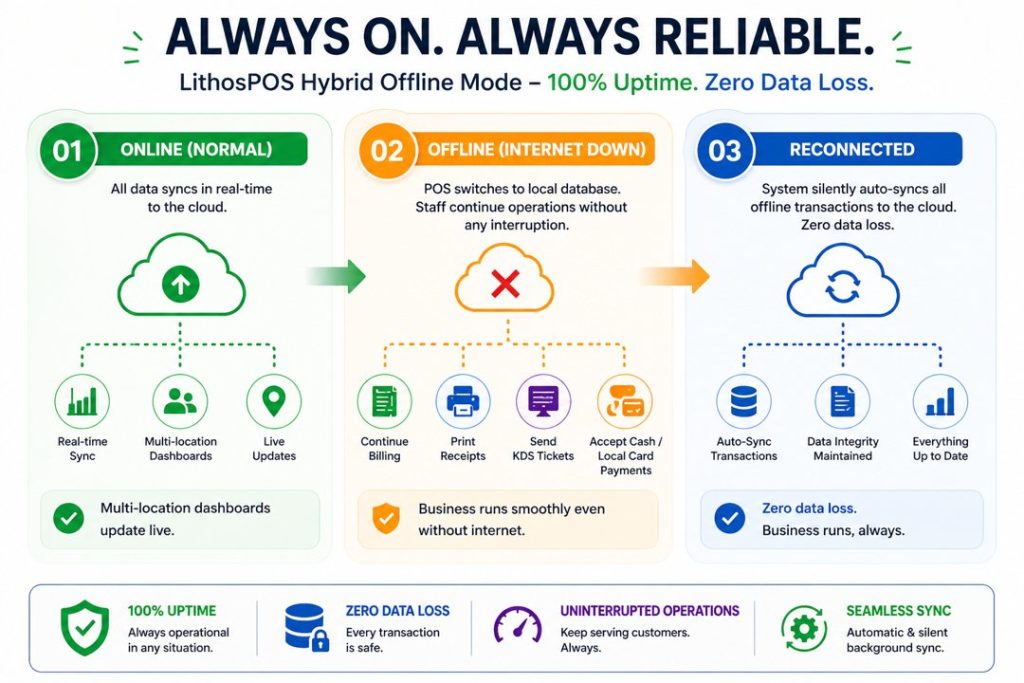
Short answer: With a hybrid offline POS, nothing happens — business continues as normal. The system processes sales, prints receipts, and sends orders to the kitchen using a local database. When the internet returns, everything auto-syncs to the cloud.
As the industry shifted to cloud-based POS systems, a critical vulnerability emerged: internet dependency. For a busy retail store or a packed Friday-night restaurant, an internet outage used to mean a complete business shutdown.
In 2026, businesses refuse to accept downtime. The industry standard is now the Hybrid Offline Mode.
How Hybrid Offline POS Works
Why This Matters for Global Businesses
For businesses operating in regions with inconsistent internet infrastructure, such as Southeast Asia, the Middle East, Africa, island nations, and developing markets, a hybrid offline capability is not a feature. It is a survival requirement. The World Bank Digital Development reports that over 2.7 billion people still lack reliable broadband, making offline-capable systems essential for global commerce.
How LithosPOS Guarantees Uptime
LithosPOS was purpose-built with island and developing-market infrastructure in mind. Our Hybrid Offline Mode guarantees 100% operational uptime. Your staff can open the cash drawer, print receipts, process orders, and send tickets to the KDS even with zero internet. The moment connectivity returns, all data syncs seamlessly. Your business never stops, even when your internet provider does.
7. Self-Service Kiosks and QR Code Mobile Ordering
What is self-service ordering in restaurants and retail?
Short answer: Self-service ordering allows customers to browse menus or product catalogs, place orders, and complete payments entirely on their own using in-store kiosks, their own smartphones via QR codes, or mobile apps without waiting for staff assistance.
The self-service revolution that began in major fast-food chains has now reached mid-sized restaurants, boutique retail stores, and grocery chains. Customers in 2026 prioritize speed and control over their ordering experience.
Self-Checkout in Retail
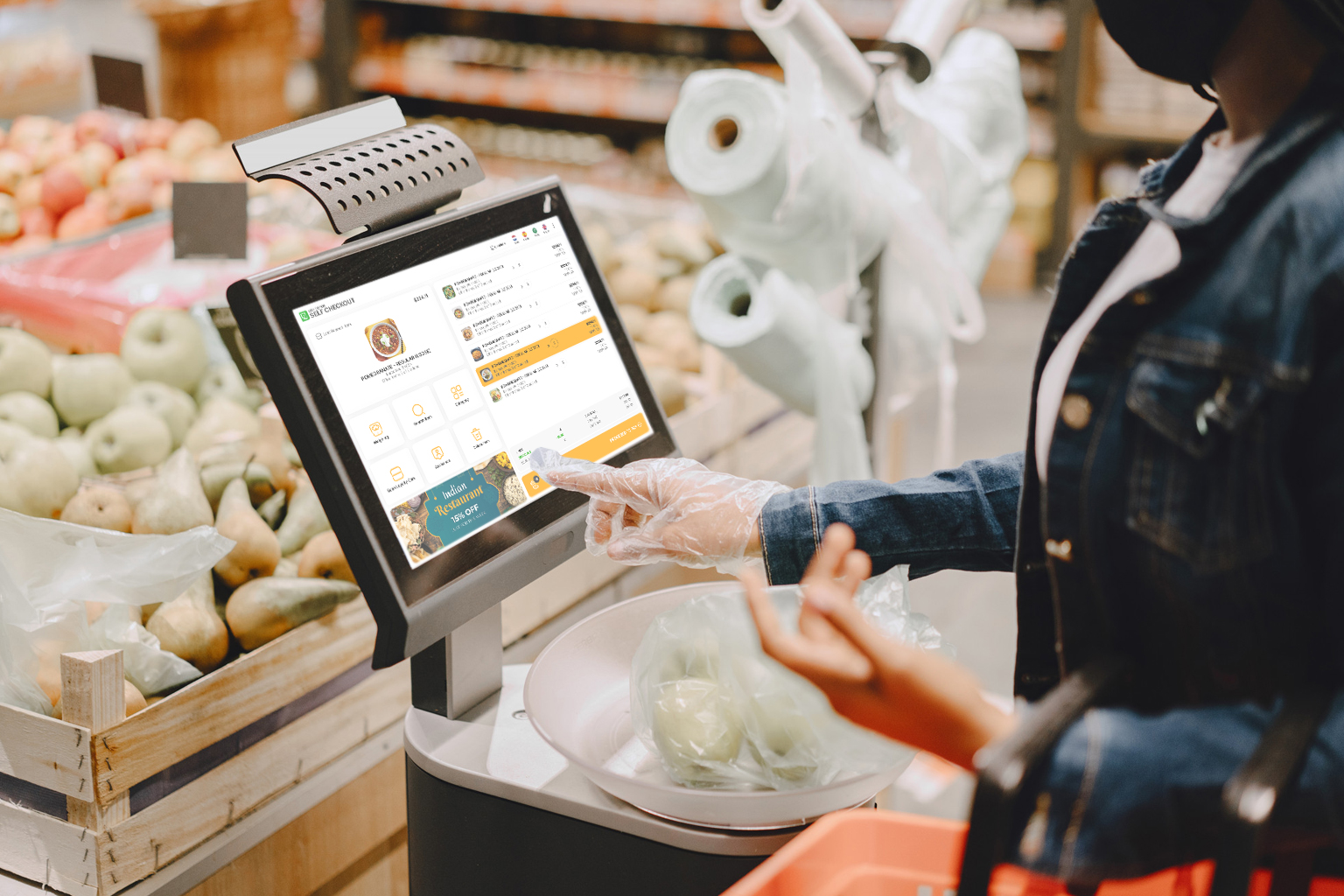
More retail stores, from boutiques to grocery chains, are deploying tablet-based self-checkout kiosks that require minimal staff intervention. Combined with AI-assisted cameras for loss prevention, these kiosks deliver a fast, frictionless checkout experience. According to RBR Data Services, the number of self-checkout terminals globally is expected to exceed 2 million units by 2027.
QR Code 2.0: Interactive Mobile Ordering for Restaurants
The static PDF QR code menus from the pandemic era have evolved into fully interactive digital ordering experiences:
The customer sits down and scans the QR code on the table
A rich, visual menu loads on their smartphone (no app download required)
They browse, customize, and send their order directly to the bar or kitchen
They pay using Apple Pay, Google Wallet, or any digital payment method 5. The entire experience happens without waiting for a server
The entire experience happens without waiting for a server
Does Self-Service Replace Staff?
No. Self-service doesn’t eliminate hospitality; it enhances it. By offloading transactional tasks (taking orders, processing payments) to the customer, your team is freed to focus on what humans do best: providing exceptional service, upselling, and managing the floor. Harvard Business Review research confirms that businesses combining self-service technology with attentive human staff report the highest customer satisfaction scores.
Frequently Asked Questions (FAQ)
What is the best POS system for restaurants in 2026?
The best restaurant POS system in 2026 should offer AI-powered analytics, unified delivery aggregation (Uber Eats, DoorDash, Zomato on one screen), a Kitchen Display System, hybrid offline mode, and hardware-agnostic deployment. LithosPOS checks all these boxes and supports 50+ integrations out of the box.
How does the free trial of LithosPOS work?
You can try all Lithospos’s features free for 14 days. There’s no commitment. We won’t ask for your credit card or payment information.
Can a POS system work without internet?
Yes. Modern hybrid POS systems like LithosPOS operate on a dual architecture, cloud-first with a robust local database. If the internet drops, you continue processing sales, printing receipts, and managing orders. All data auto-syncs when connectivity returns. Learn more about LithosPOS offline mode.
What is the difference between a cloud POS and a legacy POS?
A legacy POS stores data locally on proprietary hardware, requires manual updates, and cannot integrate easily with delivery platforms or modern payment methods. A cloud POS like LithosPOS stores data in the cloud, updates automatically, runs on any device, and integrates with 50+ third-party platforms, including delivery apps, accounting software, and payment gateways.
Is voice ordering the future of POS?
Voice ordering is one of the fastest-growing POS trends in 2026, especially in drive-thru and quick-service environments. AI-powered voice bots reduce order time by 20-40 seconds per transaction and improve upselling consistency. Gartner predicts that by 2028, over 30% of all QSR orders will involve some form of voice AI assistance.
What is a hardware-agnostic POS?
A hardware-agnostic POS is software that runs on any device, iPads, Android tablets, Windows PCs, or industry hardware like SUNMI and PAX, without requiring proprietary equipment. This gives business owners the freedom to use affordable, off-the-shelf devices instead of expensive vendor-locked terminals.
Conclusion: Is Your Business Ready for the Future of POS?
The point-of-sale industry in 2026 has moved from transactional to transformational. AI predictive analytics, voice ordering, hardware freedom, hybrid offline reliability, and omnichannel delivery integration all point toward one goal: making your business faster, more resilient, and more profitable.
If your current POS system forces you into expensive hardware, crashes when the internet drops, or requires manual order re-entry from delivery tablets, you are losing money every single day.
It is time to upgrade.
LithosPOS is a cloud-based, hardware-agnostic POS platform purpose-built for modern retail and restaurant businesses across 40+ countries. With true Hybrid Offline Mode, AI-powered analytics, 50+ integrations, and deployment on any device, LithosPOS gives you the power of tomorrow – today.
Ready to future-proof your business?
Book a Free Demo with LithosPOS and see how 50,000+ businesses worldwide are already running on the future of point-of-sale technology.
The checkout experience can make or break a customer’s entire shopping journey. Over the past few years, retailers have been asking themselves one critical question: Should we invest in self-checkout technology or stick with traditional staffed checkouts? The answer isn’t black and white, but understanding the differences between these two approaches will help you make the right decision for your business.
But here’s the thing, self-checkout isn’t a one-size-fits-all solution. Some retailers have embraced it wholeheartedly, while others have pulled back due to concerns about theft and customer satisfaction. Understanding both the strengths and weaknesses of self-checkout versus traditional checkout will help you decide what makes sense for your business.
What Is Self-Checkout, and How Does It Work?
Self-checkout systems allow customers to scan items, process payments, and complete their purchase without assistance from a cashier. Modern self-checkout solutions like LithosPOS Self-Checkout use advanced technology, including barcode scanning, touchscreen interfaces, weight sensors, age verification, and integrated payment processing.
LithosPOS Self-Checkout offers features specifically designed to create a frictionless checkout experience:
Intuitive Touchscreen Interface: Customers can easily navigate through the checkout process with clear prompts and instructions
Real-Time Inventory Integration: Tracks sales data as items are scanned, updating inventory automatically
Age-Restricted Item Detection: Automatic verification for items like alcohol and age-gated products
Receipt Options: Digital or printed receipts based on customer preference
Multi-Language Support: Accommodates diverse customer bases
Analytics and Reporting: Detailed insights into transaction patterns and peak times
These features work together to create a more independent shopping experience while maintaining security and accuracy.
Understanding Traditional Checkout
Traditional checkout is the classic model we’ve all experienced: customers line up with their items, a cashier scans everything, the customer pays, and they leave. It’s straightforward, personal, and has been the retail standard for decades. Traditional checkout still has several advantages that keep it relevant:
Personal Interaction: Cashiers can provide customer service, answer questions, and offer product recommendations
Accessibility: It’s easier for elderly customers, those unfamiliar with technology, or people with disabilities
Handling Complex Transactions: Returns, refunds, and special requests are easier with a trained employee
Building Customer Relationships: Regular customers appreciate familiar faces and personal connections
Premium Service Feel: Some retailers use checkout as an opportunity to deliver exceptional service
For many years, traditional checkout was simply the way retail worked. And in many settings, it still works beautifully.
Self-Checkout vs Traditional Checkout: A Detailed Comparison
1. Speed and Efficiency
Self-Checkout: Self-checkout is often faster for customers purchasing small quantities of items. There’s no waiting in line, and customers move at their own pace. However, unexpected item issues (like age verification for alcohol or weight sensor problems) can slow things down.
Traditional Checkout: For large basket sizes, traditional checkout can actually be faster since a trained cashier scans items at a consistent, quick pace. But during peak hours, customers face waiting times in checkout lines, which is one of the biggest pain points in retail.
Winner: Self-checkout for small purchases and off-peak hours; traditional checkout for large baskets and trained efficiency.
2. Customer Satisfaction
Self-Checkout: Satisfaction varies widely. Customers who are tech-savvy and buying just a few items love it. But frustration sets in quickly when the weight sensor malfunctions, items require age verification, the interface isn’t intuitive, or technical glitches occur. Modern solutions like LithosPOS Self-Checkout address many of these issues with user-friendly interfaces and quick staff assistance buttons.
Traditional Checkout: Customer satisfaction tends to be higher when cashiers are friendly and knowledgeable, wait times are minimal, the cashier remembers regular customers, and there’s genuine customer service. The downside? Long lines during busy periods kill satisfaction scores.
Winner: Traditional checkout for overall satisfaction, but modern self-checkout systems are closing the gap.
3. Cost Considerations
Self-Checkout: Initial investment is significant; self-checkout kiosks can be costly depending on features and capabilities. Installation and maintenance add ongoing costs. However, you reduce labor costs since fewer cashiers are needed.
Traditional Checkout: Lower upfront costs for the checkout counter itself, but labor costs are your biggest expense. A full-time cashier earning $15/hour with benefits costs roughly $30,000-$40,000 annually. A store might need 5-10 cashiers, depending on size and hours.
Winner: For high-volume stores, self-checkout wins on long-term cost savings. For small shops with low transaction volumes, traditional checkout is more cost-effective.
4. Theft and Shrinkage
Self-Checkout: This is where self-checkout faces serious challenges. Studies show that shrinkage (loss from theft or mistakes) at self-checkout is often higher than traditional checkouts. Customers accidentally miss scanning items, and some deliberately bypass scanning. The LithosPOS Self-Checkout system addresses this with weight sensors and AI-powered item detection, but the issue persists across the industry.
Traditional Checkout: Trained cashiers catch mistakes and suspicious behavior naturally. Shrinkage is lower because there’s immediate accountability.
Winner: Traditional checkout for loss prevention, though modern self-checkout systems are improving.
5. Customer Demographics and Accessibility
Self-Checkout: Works best for tech-savvy customers, people buying small quantities, customers in a hurry, and younger demographics. Doesn’t work well for elderly customers unfamiliar with technology, people with disabilities, non-English speakers, or those buying large quantities.
Traditional Checkout: Accessible for virtually everyone. Cashiers can slow down, explain steps, and accommodate different needs.
Winner: Traditional checkout for accessibility and inclusivity.
6. Upselling and Customer Engagement
Self-Checkout: There’s a limited opportunity for upselling or customer engagement, as customers typically scan items and complete their purchase quickly. However, LithosPOS addresses this by offering intelligent product suggestions and frequently bought together recommendations, helping businesses drive upsells seamlessly during the billing process.
Traditional Checkout: Skilled cashiers can recommend complementary products, mention promotions, or suggest seasonal items.
Winner: Traditional checkout for relationship-building and upselling. LithosPOS addresses this by offering intelligent suggestions and frequently bought together recommendations.
7. Labor and Staffing
Self-Checkout: Reduces the number of cashiers needed. However, you still need staff to monitor kiosks, assist customers, verify ages, and handle exceptions.
Traditional Checkout: Requires consistent staffing and creates scheduled employment.
Winner: Self-checkout for reducing staffing during labor shortages; traditional checkout for providing jobs.
The Real-World Trade-Offs
Here’s what most successful retailers have learned: it’s not about choosing one or the other, it’s about finding the right mix for your business. Grocery stores and supermarkets typically use 70-80% self-checkout and 20-30% traditional checkout. Quick-service restaurants lean heavily on self-ordering kiosks and self-checkout. Luxury retail stores often skip self-checkout entirely, preferring high-touch customer service. Small independent retailers typically stick with traditional checkout because the investment doesn’t pay off with their transaction volumes.
What Does the Future Look Like?
Self-checkout technology is improving rapidly. AI-powered item recognition is becoming more accurate. Biometric payments and mobile integration are making the process faster. Voice-activated checkouts are emerging. Modern platforms like LithosPOS Self-Checkout are continuously updating to address customer pain points. At the same time, some retailers are pulling back from pure self-checkout, recognizing that human interaction still matters, especially as a competitive advantage in an increasingly digital world.
Making the Right Choice for Your Business
Choose self-checkout if you have:
High transaction volume with small basket sizes
Young, tech-savvy customer base
Significant labor costs or labor shortages
Multiple locations where standardization matters
Budget for initial investment and ongoing maintenance
Ability to monitor kiosks and prevent theft
Stick with traditional checkout if you have:
Low transaction volume
Large average basket sizes
Older customer demographic
Limited budget for new technology
Strong emphasis on customer service and relationships •
Complex transactions (returns, special orders)
Need for high accessibility and inclusivity
Use a hybrid approach if you have:
Medium to high transaction volume
Mixed customer demographics
Budget for both solutions
Ability to staff and maintain both systems
Desire to accommodate different customer preferences
Implementing Self-Checkout Successfully
If you decide self-checkout is right for your business, here’s what success looks like:
1. Choose the right platform:LithosPOS Self-Checkout is designed specifically for retail and food service businesses.
2. Train staff properly: Your monitoring staff needs to be customer-service oriented.
3. Monitor and adjust: Track shrinkage data, customer satisfaction scores, and transaction times.
4. Communicate clearly: Let customers know where self-checkout is available and how to use it.
5. Maintain the technology: Regular software updates and hardware maintenance are critical.
The Bottom Line
Self-checkout and traditional checkout aren’t competitors; they’re different tools for different situations. The best retail experiences offer customers choice and flexibility. Technology like LithosPOS Self-Checkout has made self-service faster, more reliable, and more customer-friendly than ever before. But it works best alongside traditional checkout, not as a replacement for it.
The future of retail checkout isn’t about picking a winner. It’s about understanding your customers, your business model, and your capabilities, and choosing the approach that best serves them. Your customers are already voting with their feet. Watch where they go, listen to their feedback, and be willing to adapt. That’s the real secret to checkout success.
Ready to explore self-checkout for your business?
If you’re considering implementing self-checkout in your retail or food service operation, LithosPOS Self-Checkout offers advanced features designed specifically for modern retailers. Learn more about features like real-time inventory integration, age verification, payment processing, and detailed analytics by visiting LithosPOS Self-Checkout. Whether you choose self-checkout, traditional checkout, or a hybrid approach, the goal is the same: making your customers’ experience faster, easier, and more enjoyable.
In 2026, retail and restaurant businesses will no longer be run only by owners, managers, or supervisors. A major part of daily decision-making now happens quietly in the background, powered by POS software. What was once limited to billing has evolved into a silent manager that oversees operations, reduces errors, and keeps businesses running smoothly without constant human intervention.
This shift isn’t about replacing people. It’s about enabling smarter, faster, and more consistent operations in an increasingly complex business environment.
The Evolution of POS Software Beyond Billing
Traditional POS tools focused on one job: completing transactions. But modern POS software in 2026 has expanded far beyond that role. It now monitors inventory movement, tracks sales patterns, highlights inefficiencies, and ensures accuracy across every transaction.
For retail stores and restaurants handling high volumes, multiple staff members, and varied payment methods, this evolution is no longer optional. POS software acts as a central control system, silently coordinating tasks that once required manual supervision.
The Rise of the “Silent Manager”
A silent manager doesn’t give instructions or demand attention. Instead, it works continuously in the background, ensuring operations stay aligned.
In retail and restaurant environments, POS software now:
Automatically updates inventory after every sale
Ensures price consistency across products and locations
Tracks peak hours and sales trends
Flags discrepancies without disrupting workflow
Maintains accurate records for reporting and compliance
This behind-the-scenes automation reduces the dependency on constant oversight and minimizes the risk of human error.
Why Accuracy Matters More Than Ever in 2026
Customer expectations in 2026 are shaped by speed and reliability. A delayed bill, incorrect price, or missing item can damage trust instantly.
POS software plays a critical role in maintaining accuracy by:
Syncing product prices in real time
Preventing manual billing mistakes
Ensuring stock levels reflect actual availability
Reducing mismatches between sales and inventory
For restaurants, this accuracy extends to kitchen orders, table management, and payment reconciliation. For retail stores, it ensures smoother checkouts and better stock planning.
Data That Works Quietly but Powerfully
One of the most underrated aspects of modern POS software is how it handles data. Instead of overwhelming business owners with complex dashboards, POS solutions in 2026 simplify insights.
Sales reports, inventory summaries, and performance metrics are generated automatically and ready when needed. This allows owners to:
Identify best-selling items
Understand slow-moving stock
Plan purchases more efficiently
Make informed decisions without guesswork
This form of business intelligence works silently, but its impact is significant.
Offline Reliability Still Matters
Despite advances in connectivity, uninterrupted internet access isn’t guaranteed everywhere. That’s why offline-capable POS software remains highly relevant in 2026.
This ensures business continuity and protects revenue, especially for stores and restaurants operating in high-traffic or remote locations.
Reducing Operational Stress for Business Owners
Managing a retail store or restaurant often means juggling staff, suppliers, customers, and finances. POS software reduces this burden by handling repetitive operational tasks.
Instead of manually checking stock, reviewing registers, or reconciling sales, business owners can rely on their POS software to maintain order. This shift allows them to focus more on growth, customer experience, and strategy.
POS Software as a Growth Enabler
In 2026, POS software isn’t just a tool; it’s a foundation for scalable growth. Whether managing one store or multiple locations, modern POS solutions support expansion by:
Centralizing operations
Standardizing processes
Providing unified reporting
Ensuring consistency across outlets
This silent management layer makes growth more predictable and less chaotic.
The Future Is Quiet, Smart, and Efficient
The most powerful changes in business operations often go unnoticed. POS software in 2026 doesn’t demand attention, yet it plays a crucial role in keeping retail and restaurant businesses efficient, accurate, and resilient.
By quietly managing data, transactions, and workflows, POS software allows businesses to operate with confidence without micromanagement or constant firefighting.
In the years ahead, success won’t depend on working harder, but on working smarter. And for many businesses, that smart work is already happening silently right at the point of sale.
If you want to make your business run smoothly with fewer errors and better control, try POS software like LithosPOSand experience smarter operations every day. Get a free trial today.
Running a retail store or restaurant is not just about making sales. It is about understanding what is actually happening behind those numbers. Many business owners feel confident when the cash counter looks busy or the store is crowded. But does that really mean your business is performing well?
The truth is, without clear data and meaningful insights, it is easy to miss what is working, what is not, and where money is silently leaking. This is where business analytics and reporting become essential.
Why Feeling Busy Is Not the Same as Performing Well
A common mistake among small and growing businesses is relying on gut feeling. You may feel that sales are increasing, inventory is under control, or staff performance is fine.
But unless you are tracking the right metrics, these assumptions can be misleading.
For example:
Are profits growing, or is it just sales volume?
Are certain products selling well while others remain unsold?
Are peak hours being fully utilised?
Are billing errors affecting revenue?
Without proper reporting, these questions remain unanswered.
What Does Business Performance Really Mean?
Business performance goes beyond daily sales totals. It includes:
Sales trends across days, weeks, and months
Product and category performance
Inventory movement and stock ageing
Payment method breakdown
Staff efficiency and error tracking
Peak hours and customer behaviour patterns
Modern businesses rely on POS analytics and reporting to track these insights in real time rather than waiting for end-of-month summaries.
The Problem With Manual Reports and Spreadsheets
Many retailers and restaurant owners still depend on manual registers, spreadsheets, or handwritten end-of-day reports.
While this approach may seem manageable, it often leads to:
Delayed and inaccurate data
Missed errors
Poor visibility into trends
Reactive decision-making
Manual reporting also becomes difficult to manage when a business grows or operates across multiple locations.
How POS Analytics Changes the Way You See Your Business
A modern POS solution with built-in analytics allows business owners to move from guesswork to clarity.
This visibility helps owners take timely action, whether it is restocking fast-moving items, adjusting pricing, or improving staff scheduling.
Real-Time Data Leads to Better Decisions
One of the biggest advantages of POS analytics is real-time reporting. Instead of waiting days or weeks for insights, you can see business performance as it happens.
This helps businesses:
Reduce inventory waste
Avoid stock shortages
Control operational costs
Improve cash flow
Increase profitability
POS software like LithosPOS is designed to provide clear and actionable insights without overwhelming users with complex data.
Analytics for Retail and Restaurant Businesses
Analytics needs vary slightly across industries, but the goal remains the same: better control and smarter decisions.
For Retail Businesses:
Product performance analysis
Inventory turnover reports
Category-wise sales insights
Payment method trends
For Restaurants and Cafes:
Peak hour analysis
Menu item performance
Order volume tracking
Staff-wise billing accuracy
POS analytics help businesses understand what drives revenue and where improvements are needed.
Simplifying Multi-Location Performance Tracking
For businesses operating multiple outlets, tracking performance can become challenging. Centralised POS reporting makes this easier by offering:
Location-wise sales comparisons
Consolidated reports
Central inventory visibility
Unified performance dashboards
This ensures consistency across outlets and supports confident business expansion.
Why Cloud-Based POS Reporting Matters
Cloud-based POS reporting ensures business data is accessible anytime and from anywhere. It also offers better data security, automatic backups, and real-time updates.
This is especially useful for owners who want visibility into operations without being physically present at the store every day.
Are You Using Data or Just Collecting It?
Many businesses collect data but fail to use it effectively. Real business intelligence comes from understanding trends, asking the right questions, and acting on insights.
A POS solution with smart analytics turns raw data into clear answers, helping owners truly understand how their business is performing.
Final Thoughts
If you are unsure about your sales trends, inventory movement, or operational efficiency, it may be time to rethink how you analyse your business.
POS software like LithosPOS helps retail and restaurant businesses gain clarity through powerful analytics and reporting, without unnecessary complexity. With operations across more than 40 countries, it supports growing businesses with real-time insights and better control.
Want to understand your business performance better? Try a free trial or book a demo to see how data-driven decisions can transform the way you run your retail/F&B business.
Small retailers often feel the pressure first when economic conditions shift. Reduced footfall, rising operational costs, supply chain disruptions, and shrinking profit margins make day-to-day operations more challenging. However, many resilient retailers successfully navigate tough times by relying on smart, data-driven tools. One such tool is POS software, a powerful solution that improves efficiency, reduces waste, and supports better decision-making.
In this blog, we explore howPOS software helps small retailers survive tough times, stabilise operations, and stay competitive even during economic downturns.
1. Improving Inventory Accuracy to Reduce Losses
During slow economic periods, every product on the shelf matters. Overstocking ties up capital, while understocking results in missed sales. POS software provides accurate, real-time inventory visibility so retailers can:
Track stock levels instantly
Reduce dead stock and over-purchasing
Forecast demand with historical sales trends
Identify best-selling and slow-moving items
Effective inventory management is one of the strongest survival strategies for small retailers, especially when controlling costs becomes a priority.
2. Reducing Human Error with Automation
Manual processes increase the chances of mistakes, misbilling, duplicate entries, incorrect discounts, and stock mismatches. These errors become expensive during tough economic conditions.
With fewer mistakes and better accuracy, retailers can safeguard their margins.
3. Faster Checkout to Improve Customer Satisfaction
Slow checkout experiences often drive customers away. During difficult economic periods, shoppers become more selective and prefer businesses that value their time.
This leads to shorter queues, better customer satisfaction, and higher chances of repeat visits. Even when demand fluctuates, a fast checkout process helps maintain consistent sales.
4. Data-Driven Decisions with Real-Time Business Insights
Tough times require smarter decision-making, not assumptions. POS software gives small retailers actionable insights through:
Daily sales reports
Category-wise performance
Hourly or seasonal trends
Customer buying patterns
Profit margins and cost reports
When retailers know exactly what is selling, what isn’t, and when customers prefer to shop, they can plan promotions, stock purchases, and staffing more effectively. This data-driven approach protects profitability and reduces unnecessary expenses.
5. Supporting Multi-Channel Selling to Increase Revenue
When foot traffic drops, retailers must diversify their selling channels. Instead of shifting fully to online operations, small retailers can start online sales alongside their offline store.
By reaching customers across different channels, retailers reduce dependency on walk-ins and maintain steady revenue flow even in downturns.
6. Building Strong Customer Loyalty During Downturns
Customer retention becomes more important when acquiring new customers becomes expensive. POS software plays a big role in strengthening customer loyalty by enabling:
Loyalty points
Exclusive member offers
Digital receipts
Customer purchase history
Personalized recommendations
When customers feel valued, they are more likely to return even during difficult economic conditions. This ensures stable revenue and long-term relationships.
7. Maintaining Business Continuity with Offline Functionality
Internet disruptions can stop billing and create frustration for both staff and customers. In tough times, retailers cannot afford downtime.
This reliability protects revenue and builds customer trust.
8. Strengthening Long-Term Business Stability
Tough times require adaptability, and POS software gives small retailers the flexibility they need. With better data, faster processes, and reduced operational costs, retailers can:
Keep their business steady
Retain customers
Increase profitability
Make smarter decisions
Compete with larger retailers
Technology becomes the backbone that helps retail businesses survive and grow even in unpredictable markets.
If you want to use a modern, efficient POS solution…
POS software like LithosPOSsupports small retailers with powerful tools for billing, inventory management, payments, customer loyalty, analytics, and multi-channel operations all in one place. It’s designed to help retail businesses stay efficient, accurate, and profitable in any economic condition.
LithosPOS is trusted by businesses in 50+ countries and continues to help retailers simplify operations and grow steadily.
Expanding your business across multiple locations is a big achievement, but it comes with its own set of challenges. Whether you’re running a restaurant chain, a retail franchise, or a group of convenience stores, managing operations across several outlets can become overwhelming without the right tools.
In this blog, we’ll explore why multi-location management is important, the key challenges businesses face, and how LithosPOS helps solve them while boosting operational efficiency and customer satisfaction.
What is Multi-Location POS Software?
Multi-location POS software is designed to manage sales, inventory, staff, and reporting across various outlets under a single system. Rather than managing each location separately, it allows business owners to get a centralized view and manage operations in real-time, regardless of geographic distance.
Why Multi-Location Management Matters
As businesses grow and expand across different towns, cities, or even countries, maintaining consistency in operations becomes increasingly difficult. Every outlet might have its staff, customer base, and inventory needs. Without centralized control, these differences can lead to miscommunication, inefficiencies, and lost revenue.
Here’s why managing multiple locations from a unified platform is critical:
Ensures consistent pricing and promotions
Provides visibility into each location’s performance
Reduces manual errors in stock management
Improves staff accountability
Enhances the customer experience
Top Challenges in Managing Multiple Store Locations
Let’s break down the most common pain points faced by multi-location businesses:
1. Inventory Inconsistency
Stock discrepancies between outlets can lead to overstocking, stockouts, and missed sales opportunities.
2. Disjointed Sales Data
Without a unified system, collecting and analyzing data across branches is time-consuming and error-prone.
3. Poor Staff Coordination
Different teams working independently without a central system can cause misaligned processes and customer service issues.
4. Lack of Real-Time Insights
Delayed or inaccurate reporting hampers strategic decision-making.
5. Inconsistent Customer Experience
If loyalty programs or customer data are not synced, customers may receive a fragmented experience when visiting different outlets.
How LithosPOS Solves Multi-Location Management Issues
LithosPOS is a comprehensive, cloud-based POS solution designed to streamline operations across multiple locations. Here’s how it makes a difference:
✅ Centralized Dashboard
LithosPOS provides a single control panel to manage every outlet. Whether you have two branches or twenty, you can track sales, inventory, and employee performance from one place anytime, anywhere.
✅ Real-Time Inventory Sync
The platform updates stock levels in real-time across all locations. You can transfer inventory between stores easily, monitor low-stock alerts, and avoid duplicate ordering.
✅ Location-Based Pricing & Promotions
Customize pricing, taxes, and offers based on store location. This is especially useful for businesses operating in different cities or regions with varying customer preferences and regulatory requirements.
✅ Branch-Specific Reports
Generate insightful reports for individual locations or view overall performance. LithosPOS allows you to filter data by region, store, or time to understand what’s working and what needs improvement.
✅ Unified Customer Management
Customer data, such as purchase history, loyalty points, and preferences, is stored centrally. This helps you offer consistent and personalized experiences across all branches.
✅ Employee Role & Access Management
Assign staff roles and control permissions per location. This improves security and ensures each employee has access only to the tools they need.
✅ Offline Mode
Even in areas with unstable internet, your outlets can continue to operate without interruptions. Transactions are stored locally and synced once the connection is restored.
Answering Common Questions
Q1: How can I manage multiple business locations from one platform?
By using POS software like LithosPOS], which offers a centralized dashboard to control inventory, sales, staff, and customer data across all outlets.
Q2: Can I transfer inventory between store branches using LithosPOS?
Yes. LithosPOS allows seamless stock transfers between locations, helping you balance inventory and prevent shortages or overstocking.
Q3: Is it possible to run each outlet independently while keeping data centralized?
Absolutely. Each branch operates independently, but all data is synced in real time and accessible from your central dashboard.
Q4: Does LithosPOS support offline operations for remote locations?
Yes. Outlets can continue operations without internet, and all data will automatically sync once connectivity is restored.
Q5: Can I generate location-specific performance reports?
Yes. LithosPOS offers advanced reporting filters so you can view performance metrics for each outlet or analyze overall trends.
Future-Proof Your Business Growth
As your business grows, managing multiple stores should be a strategic advantage, not a logistical nightmare. By investing in a robust POS solution like LithosPOS, you equip your team with the tools they need to stay efficient, consistent, and customer-focused across every location.
Conclusion: Simplify, Scale, and Succeed with LithosPOS
Managing multiple store locations doesn’t have to be complex. With LithosPOS, you can unify your operations, empower your staff, and deliver an exceptional customer experience everywhere you do business.
From inventory synchronization to location-specific pricing and centralized reporting, LithosPOS is built to support growing businesses that operate in more than one location.
Operating the restaurant in 2025 has more than just great food and the primary place. It requires careful balance with intelligent operations, employees, and a trouble-free experience with customers, all supported by the right technology. The landscape of the restaurant is changing quickly, and those who adapt will prosper.
So, what is the secret sauce for the long-term success of the restaurant?
Let’s explore the ingredients that make it work.
1. Master Your Inventory: Waste Less, Profit More
Inventory management is not just about what is in stock – it is about avoidance, reduction of waste, and increasing profitable margins. In 2025, modern restaurant owners use real-time supply monitoring in order to get a clear view of patterns, low stocks, and automated overworking systems.
POS software, such as LithosPOS, simplifies this process by providing automated stock messages and monitoring consumption at the level of folders. Instead of manual stock counting, you will have everything you need at your fingertips, and make a smarter decision and minimize the loss.
2. Empower Your Staff With Smart Tools
Your team is your biggest asset. When employees are self-confident and well equipped, the service and decrease are improved. Today’s best restaurants use planning applications, performance panels, and mobile tools that help employees stay in the organization and be effective.
With LithosPOS, you can assign roles, manage employees’ access, and monitor performance in all places – directly from your POS. It also supports waiters’ applications and allows servers to receive orders directly from the table and shortening waiting times and errors. This not only increases productivity but also improves the experience of guests.
3. Make Data-Driven Decisions
Data is a new spice in your recipe for success. From knowing which food is a bestseller to identifying slow hours, they are necessary to optimize performance. Checking daily sales, customer formulas, and product movement will help you effectively adjust the offer, price, and marketing strategies.
LithosPOS provides detailed sales and performance reports to help you analyze trends and act immediately. Whether you manage one or more, this level of visibility puts you under your business, allowing you to focus on growth instead of guessing.
4. Embrace Digital Experiences
In today’s fast-growing world, customers expect speed, comfort, and a touch of personalization. Contactless payments, QR menus, online ordering, and integration of delivery are not just pleasant- they are looking forward.
LithosPOS promotes online ordering, the integration of the delivery aggregator, and the possibilities of mobile payments and ensures that your customers have a trouble-free experience – whether it be ordering, paying, or paying on the go. In addition, all online and offline transactions synchronize into a single system, eliminating chaos and reducing manual work.
5. Deliver a Memorable Guest Experience
While technology plays a huge role, nothing beats warm service and an unforgettable experience. Customers are attracted to restaurants that make them feel appreciated. Personalizing service, reinforcement of repeat customers, and ensuring fast and precise orders contribute to loyalty.
With LithosPOS’s built-in customer management features, you can store guests’ preferences, create your own loyalty programs, and send targeted offers. As a result, every interaction with the customer is more meaningful, accepting repeated visits and oral recommendations.
6. Diversify Revenue Streams
Relying only on the Dine-in service is risky in today’s market. The most successful restaurants in 2025 are expanding their offers – characteristics, goods, online classes, and branded products.
LithosPOS allows you to manage multiple sales channels from one platform, whether you sell in a store, online, or at pop-up events. You can also analyze which channels bring the most income, allowing you to invest wisely and grow sustainably.
7. Operate Without Interruption
The downtime can kill the company, especially during top hours. Therefore, having a technology that works, although the Internet is not essential.
LithosPOS also works offline, so you will never miss a sale. Orders, payments, and updates synchronize as soon as you join again and ensuring continuous services and peace.
Final Thoughts
Secret sauce for the operation of a successful restaurant in 2025? It’s not just one thing- it’s a well-mixed mixture of efficient systems, happy staff, great food, and intelligent technology.
POS solutions like LithosPOS are not just tools – they are business partners who help you manage supplies, streamline operations, serve faster, and make smarter decisions every day. Whether you are starting or running a chain of stores, having the right technology on the spot will prepare you for long-term success.
Finally, the success of consistency, the connection of the customer, and the willingness to adapt. Stir the correct tools and cook success in no time.
Note to Restaurateurs: Why 2025 Is Your Year to Level Up
The operation of the restaurant has never been easy, but 2025 offers more opportunities than ever to take control, grow faster, and serve smarter. The key is that it remains proactive and uses technology as a strategic partner.
For Tip: Don’t wait for things to break before upgrading software. Restaurants that invest in digital solutions tend to adapt faster and overcome competitors. Whether you make your inventory more efficient, speed up table service, or integrate online orders, aim to simplify processes and increase customer satisfaction.
Do you need help with multiple branches, complex offers, or high-volume orders?
The scalable POS software, such as Lithospos, allows you to control everything from one location, providing you with information, automation, and flexibility without further stress.
Pro Tip: Use your POS reports to track what’s working, top-selling items, slow days, and customer habits. Let the data guide your menu, pricing, and promotions.
Remember: The future favors the prepared. With passion, strategy, and the right tools, your restaurant can thrive in 2025 and beyond.
Are you ready to streamline your restaurant operations and stay ahead in this competitive industry?
Try LithosPOS today – the ultimate partner for smarter operations and happier customers.
The restaurant is often romanticized as a dream business for food lovers and aspiring entrepreneurs. The idea of serving tasty meals, creating a pleasant atmosphere, and being your boss is attractive. Although passion is necessary, it is not enough to guarantee success. Behind the scenes, the restaurant’s operation is one of the most difficult businesses in which they succeed. High competition, operating challenges, and financial risks make it an industry that is not for everyone.
Why Running a Restaurant Is Tougher Than Ever
1. High Operating Costs
The cost of operation of the restaurant increased due to rising rent, public services, and raw material costs. Inflation and supply chain disruption made it difficult for restaurants to maintain their margins. Without proper financial planning, many restaurants are trying to stay above the water.
2. Labor Shortages and Staff Management
Finding and maintaining qualified staff has become a major challenge. Many restaurants face a high level of employee turnover that disrupts the quality of services and increases the cost of hiring and training. In addition, the management of shifts, payroll, and employee efficiency requires strong guidance and correct technology.
3. Intense Competition
The restaurant market is saturated with possibilities, from local restaurants to large franchises. Use requires more than good food-Excellent services, unique concept and intelligent marketing strategies are essential for long-term success.
4. Changing Customer Expectations
Today’s customers expect more than good food. They require fast services, digital payment options, online ordering, and a personalized experience. Restaurants that cannot adapt to these developing expectations risk losing customers to competitors who have modern technology.
5. Marketing and Brand Building
Having a great menu is not enough; You have to get people through the door. Effective marketing through social media, Google reviews, and customer involvement is essential. However, many restaurants are fighting digital marketing, leading to low visibility and declining pedestrian operation.
How Restaurants Can Overcome These Challenges with LithosPOS and Become the Best in the Market
While the restaurant business is difficult, those who adapt and implement intelligent solutions can succeed. One of the key ways to overcome these challenges is the use of technology, such as POS software like Lithospos.
Here is how Lithospos helps not only survive restaurants but also benefit:
Simplified operations: Processing of order automation, billing, and inventory management reduces manual errors, speeds up the service, and increases efficiency.
Increasing customer experience: Online ordering, more payment options, self-service kiosks, and loyalty programs help attract and maintain customers.
Intelligent stock check: Reduce waste and avoid storage with real-time stocks, ensuring cost-effective shares management.
Data-based decisions: Real-time sales access, customer preferences, and inventory reports allow better financial planning and strategic growth.
Seamless Multi-Location Management: Manage multiple stores from one control panel, ensuring a single price, a centralized message, and better assignment of resources.
By adopting LithosPOS, restaurants can automate tedious tasks, cut unnecessary costs, improve service quality, and provide a seamless experience to customers. This gives them a competitive edge, positioning them as leaders in the market.
Is the Restaurant Business Right for You?
Running a restaurant is not just about passion; it requires business acumen, resilience, and the ability to adapt to challenges. The reality is that many restaurants fail within the first few years due to poor planning and a lack of operational efficiency. However, with the right mindset, strategy, and tools like LithosPOS, restaurant owners can improve their chances of long-term success.
Final Thoughts
The restaurant industry is not for everyone, but for those willing to embrace technology and innovation, there is a path to success. If you’re considering starting or improving your restaurant business, investing in the right tools can make all the difference.
Are you ready to streamline your restaurant operations and stay ahead in this competitive industry?
Try LithosPOS today – the ultimate partner for smarter operations and happier customers.
Why do customers return to the business? Is it product quality, customer service, or trouble-free shopping?
According to several industrial publications, one overlooked factor is the diversity of available payment options. In a world where consumer preferences are rapidly evolving, your company can offer multiple payment methods of game converters that meet your business needs.
The Rise of Diverse Payment Methods
The field of payment systems has undergone significant changes in recent years. Cash and credit cards, once dominant, are now only part of a much larger ecosystem of payment options, including:
Contactless payments: TAP-and-GO options via cards or NFC-enabled smartphones offer speed and convenience.
Digital wallets: Services like Apple Pay, Google Pay, and PayPal simplify transactions for tech-savvy customers.
Buy now, pay later (BNPL): Flexible financing options offered by providers such as afterpay or Klana, popular especially among younger customers.
Cryptocurrency: A new trend among tech-savvy consumers who value decentralization and innovation.
QR code payments: widely used in regions such as Asia, providing a simple yet secure payment solution.
Why Payment Options Matter to Customers
1. Convenience
Modern customers prefer Convenience. The offer of the preferred payment method ensures faster and smoother payments, whether in a store or online. Long gone are times when customers only wore cash; Today, smooth digital transactions are expected.
2. Flexibility
Flexibility is the key to satisfying the diverse needs of your audience. Providing various payment preferences ensures inclusivity and wider appeal, from international tourists to the shopping gene.
3. Trust and security
With the increase in contactless and digital payments, customers are increasingly attracted to security-oriented methods. Biometric verification, encrypted transactions, and fraud detection functions are just some of the advantages of these modern options.
4. Inclusivity
By accepting multiple payment methods, you give customers a signal that your company is thinking in advance and is inclusive and that it values their diverse preferences.
Benefits of Expanding Payment Options for Your Business
1. Increased sale
The more payment options you provide, the more likely customers will complete their purchase. This has an impact, especially on online stores, where a common problem is to leave the truck due to limited payment options.
2 . Increased loyalty to customers
Satisfied customers return more often. Adaptation to their preferred methods of payment will create a positive and unforgettable shopping experience.
3. Competitive edge
Flexible POS software stands out in the crowded market. Customers choose a store that offers modern payment opportunities in a shop that doesn’t.
4. Operational efficiency
Robust POS solutions, such as Lithospos, consolidate various payment methods into one system, increase operations more efficiently, shorten errors, and save time for your employees.
How Lithospos stands out –
LithosPOS is designed to meet the demands of modern businesses by supporting a wide range of payment options. Here’s how it makes a difference:
Global reach: Integration with more than 50 payment services in 40 countries ensures that your business is ready to serve customers around the world.
Versatile payments: From credit and debit cards to digital wallets and contactless payments, LithosPOS has it all covered.
Real-time Tracking: Monitor transactions with real-time tracking and reporting, simplifying financial management.
Future-proof technology: Compatibility with leading payment technologies ensures your business stays ahead of the curve.
Industrial Statistics
According to research published by payments industry leaders, businesses that offer more than four payment options have up to 30% higher customer retention rates. Similarly, stores equipped with advanced POS software report reduced checkout times and improved operational efficiency, leading to happier customers and better reviews.
Conclusion
In today’s fast-paced world, it’s not about giving customers more ways to pay, it’s just pleasant – it’s necessary. People want shopping convenience, flexibility, and security, and this is where smart POS solutions like LithosPOS differ. By offering a variety of payment options, you not only meet customer expectations – you exceed them.
Think about it: smoother checkouts, happier customers, and a company that stands out from the crowd. With LithosPOS, you’re equipped to handle today’s payment trends and ready for whatever happens. It’s not just about keeping up – it’s about staying ahead of the curve and creating an experience your customers won’t forget.
LithosPOS — The ultimate partner in smarter operations and happier customers.